
Medically Reviewed By
Dr. Rabia Iqbal
Quick Snapshot
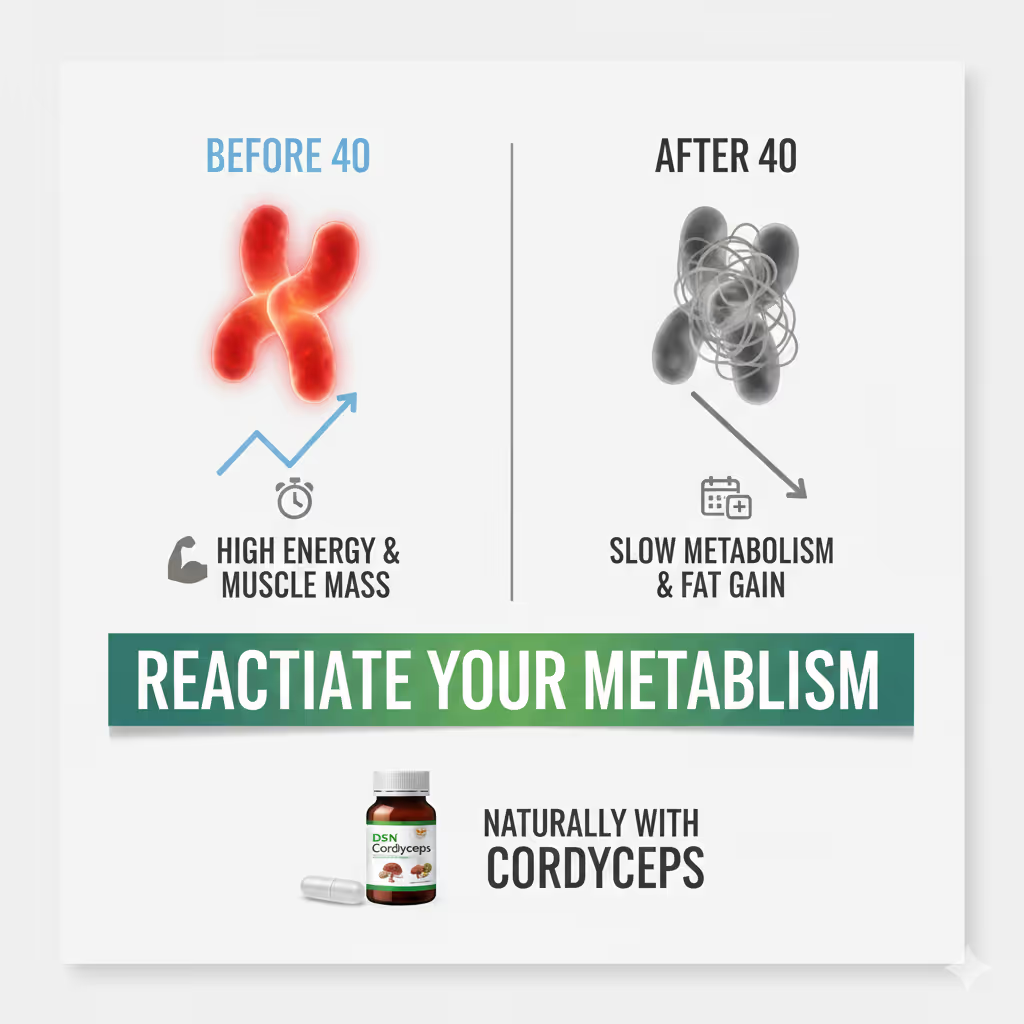
- Mitochondrial Decay: By age 40, the efficiency of the Electron Transport Chain drops by 20–30%, leading to 'electron leakage' and oxidative stress that slows metabolism.
- Sarcopenia Onset: We lose 0.5% to 1.4% of muscle mass annually after 40. This loss of metabolically active tissue lowers the Basal Metabolic Rate (BMR), causing weight gain even if calories remain constant.
- The Adenosine Key: Cordyceps contains cordycepin, a molecular mimic of adenosine that can bypass energy blockages and directly stimulate ATP synthesis.
- Thermic Effect of Protein: Increasing protein intake to 30g per meal exploits the high 'thermic effect' of food, boosting metabolic rate by 15–30% compared to carbs or fats.
- The DXN Advantage: Unlike wild harvesting, DXN's fermentation technology yields a consistent, contaminant-free mycelium rich in bioactive nucleosides essential for metabolic reactivation.
The Bioenergetic Infrastructure: Understanding ATP and Mitochondrial Decay
At the core of the metabolic slowdown is the health of your mitochondria—the microscopic organelles responsible for aerobic respiration. They produce Adenosine Triphosphate ($ATP$), the universal energy currency of the body. The efficiency of $ATP$ production is governed by the Electron Transport Chain ($ETC$).
As we age beyond 40, $mtDNA$ (mitochondrial DNA) accumulates mutations due to decades of exposure to Reactive Oxygen Species ($ROS$). This leads to:
- Electron Leakage: The $ETC$ becomes 'leaky,' letting electrons escape and form free radicals instead of generating energy.
- Reduced PGC-1α: The 'master regulator' of mitochondrial biogenesis declines, meaning we produce fewer new mitochondria to replace the old, dysfunctional ones.
- Mitophagy Failure: The body becomes slower at clearing out 'zombie' mitochondria, which clutter the cell and trigger inflammation (Inflammaging).
Sarcopenia: The Loss of the Metabolic Engine
Skeletal muscle accounts for roughly 40% of body mass and is the primary driver of your Basal Metabolic Rate ($BMR$). Sarcopenia—the age-related loss of muscle—accelerates after 40.
This is characterized by a specific loss of Type II (Fast-Twitch) fibers, which are the most metabolically expensive. Furthermore, aging muscle suffers from Myosteatosis—the infiltration of fat into the muscle fiber itself. This 'marbling' makes the muscle insulin resistant, preventing it from absorbing glucose efficiently and further lowering your daily calorie burn.
Hormonal Shifts: The Endocrine Contribution
The endocrine system undergoes a 'great depression' after 40. In women, the drop in Estradiol ($E2$) reduces mitochondrial protection. In men, declining Testosterone ($T$) reduces protein synthesis.
- Estrogen & Mitochondria: $E2$ promotes mitochondrial fusion. Its loss leads to fragmented, weak mitochondria and visceral fat gain.
- The Somatopause: Growth Hormone (GH) levels drop, reducing the body's ability to repair tissue and mobilize fat stores.
Strategy 1: Metabolic Reconditioning (HIIT & Resistance)
To reverse sarcopenia, we must engage in 'Mitochondrial Training.' Resistance training activates AMPK, a sensor that tells the cell to build more mitochondria.
- HIIT & EPOC: High-Intensity Interval Training creates an oxygen debt. The body must burn extra calories for hours post-workout to restore equilibrium—a phenomenon known as Excess Post-exercise Oxygen Consumption ($EPOC$).
- Resistance Frequency: 2–4 days per week is required to counteract the 1% annual muscle loss.
Strategy 2: The Thermic Effect of Food (TEF)
Dietary strategy must shift from calorie restriction to nutrient density. Protein has the highest Thermic Effect of Food ($TEF$).
- The Cost of Digestion: Digestion of protein increases metabolic rate by 15–30%, whereas fats only increase it by 0–3%.
- The Leucine Threshold: Older adults suffer from 'anabolic resistance.' You need 25–30g of protein per meal to trigger muscle synthesis (specifically the amino acid Leucine).
Strategy 3: Bioenergetic Supplementation with DXN Cordyceps
The most targeted way to reactivate metabolism is to address the $ATP$ deficit directly. Cordyceps sinensis contains Cordycepin ($3'-deoxyadenosine$).
Cordycepin is a structural analogue of adenosine. It acts as a molecular 'key' that bypasses metabolic blockages:
- Enhanced Oxygen ($VO_{2max}$): Cordyceps improves the oxygen-carrying capacity of the blood, allowing mitochondria to burn fuel more efficiently.
- Lactate Clearance: It speeds up the removal of lactate, preventing the 'heavy leg' feeling that discourages exercise in older adults.
- ATP Synthesis: Clinical studies show Cordyceps upregulates the enzymes responsible for regenerating $ATP$, essentially recharging the cellular battery.
Why DXN Cordyceps?
Wild Cordyceps is often contaminated with heavy metals. DXN uses a proprietary fermentation technology to cultivate pure Cordyceps mycelium. This ensures a standardized level of bioactive nucleosides without the environmental risks, providing a pharmaceutical-grade metabolic intervention.
The DXN Metabolic Stack
For a complete metabolic reset, combine Cordyceps with:
- DXN Spirulina: Provides the complete protein (60-70%) and B-vitamins needed for the Krebs Cycle.
- DXN Morinzhi: Contains enzymes and xeronine to improve nutrient absorption in the gut.
- DXN Ganoderma (RG/GL): Reduces systemic inflammation ('inflammaging') that inhibits metabolic flexibility.
Key Benefits
ATP Regeneration
Cordycepin acts as an adenosine analogue, directly stimulating the synthesis of ATP to reverse age-related cellular fatigue.
Increased VO2 Max
Enhances the body's ability to utilize oxygen during exercise, effectively raising the 'aerobic ceiling' for better fat burning.
Sarcopenia Defense
When stacked with Spirulina, it supports the preservation of lean muscle mass, which is the primary driver of resting metabolic rate.
Hormonal Support
Cordyceps has been shown to mimic LH (Luteinizing Hormone), potentially supporting healthy testosterone levels in men and libido in women.
Lactate Buffering
Accelerates the clearance of lactic acid, allowing for higher intensity workouts that trigger the EPOC (afterburn) effect.